
Single tooth implant
One implant and crown to replace a single missing tooth — without grinding down the healthy teeth on either side.
Loading...
The modern standard for replacing missing teeth. Dental implants restore your bite, protect your jawbone, and give you a permanent, natural-looking tooth — planned individually for you here in Newfoundland.
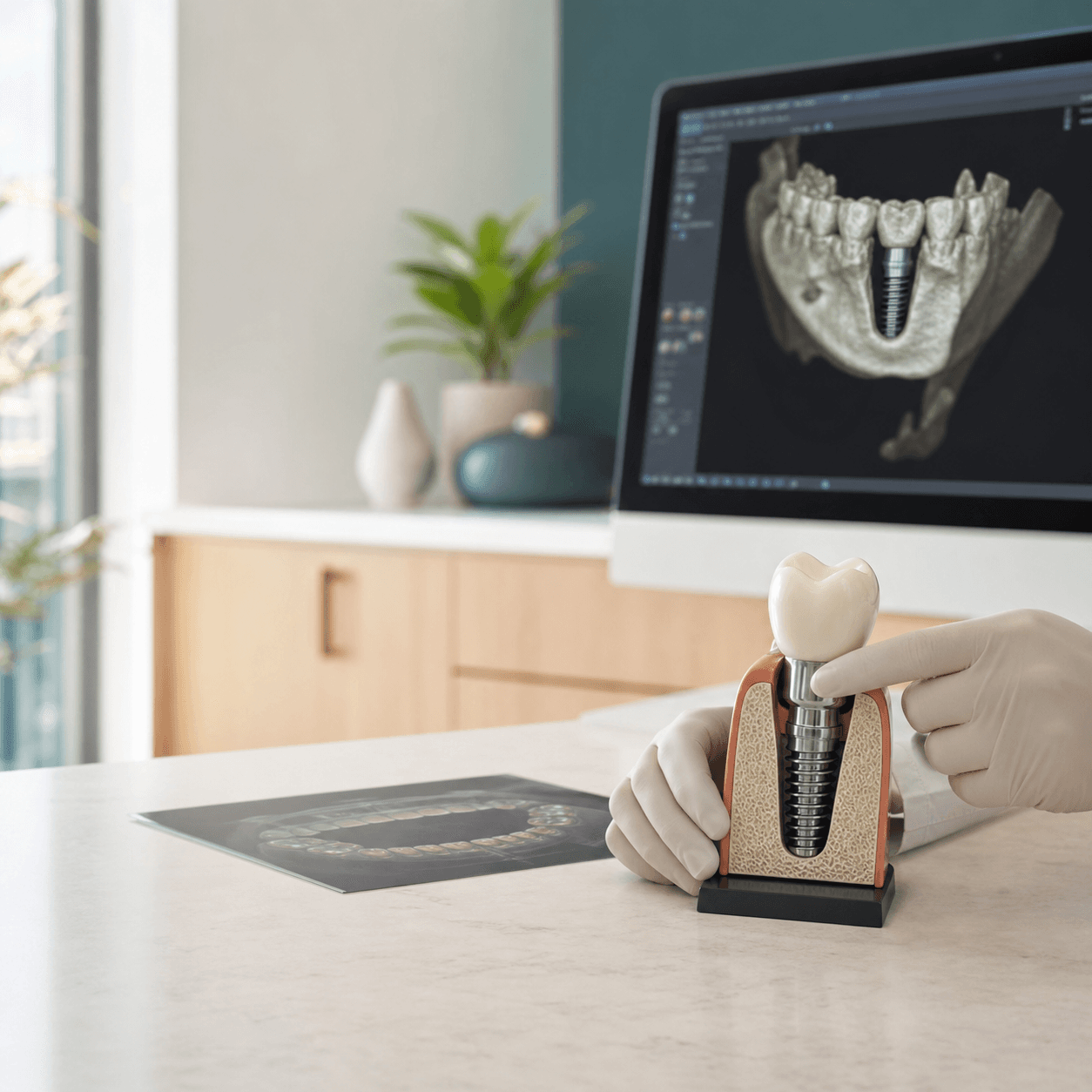
Losing a tooth affects more than your smile — it changes how you chew and speak, and over time the jawbone beneath the gap begins to shrink. A dental implant is the only tooth-replacement option that addresses all of this, because it replaces the root as well as the visible tooth.
An implant has three parts: a titanium post placed in the jaw, an abutment that connects to it, and a custom crown on top. The post fuses with your bone through a process called osseointegration, creating a stable, long-lasting foundation. The result is a replacement tooth that looks, feels, and works like the one you lost — with no slipping and no special cleaning routine.
At our St. John's practice, every implant plan starts with a careful assessment and 3D imaging so that treatment is designed around your anatomy, your health, and your goals.
Whether you're missing one tooth or an entire arch, there's an implant-based solution to consider.
One implant and crown to replace a single missing tooth — without grinding down the healthy teeth on either side.
Two or more implants can support a fixed bridge to replace several missing teeth in a row.
Crowns & bridgesA removable denture that snaps securely onto implants for far more stability than a conventional denture.
OverdenturesA fixed, full-arch set of teeth supported by as few as four implants for suitable candidates.
All-on-4 / All-on-XAn implant stimulates the jaw like a natural root, helping to slow the bone loss that follows tooth loss and preserve your facial structure.
A well-integrated titanium implant is designed to last many years — often a lifetime — and can't develop a cavity.
Because implants anchor into bone, they restore chewing strength so you can comfortably eat the foods you enjoy.
A custom, colour-matched crown is shaped to blend with your surrounding teeth so your smile looks like you.
Unlike a traditional bridge, an implant stands on its own and doesn't require reshaping the healthy teeth beside the gap.
3D CBCT imaging lets us map bone and nerves before treatment, so placement is planned around your individual anatomy.
Most adults with one or more missing teeth can be considered for implants. The key factors are having enough healthy jawbone and gums to support the implant. If some bone has been lost, a bone graft can often rebuild the area first — so patients who were told years ago they weren't suitable are frequently candidates today.
Smoking, uncontrolled diabetes, and certain medical conditions can affect healing, so we review your full health picture as part of planning. The most reliable way to find out is a consultation with 3D imaging.
Technology that supports your plan
A cone-beam CT scan gives us a detailed 3D view of your jaw so we can assess bone and place implants with precision — not guesswork.
See our technologyImplant treatment takes place over a few appointments. Here's the typical path from consultation to your new tooth.
We examine the area and take a 3D CBCT scan to assess bone volume and plan the ideal implant position. If more bone is needed, we'll discuss grafting options first.
The titanium implant is placed into the jawbone under local anaesthesia. Many patients are surprised by how straightforward this appointment is, and you won't leave with a visible gap.
Over the following months, the bone naturally fuses to the implant, creating a stable foundation. You carry on with daily life during this phase.
Once integration is confirmed, we attach the abutment and your custom crown — matched to your natural teeth for a seamless, functional result.
There's no single price, because the cost of dental implants depends on how many teeth you're replacing, whether a bone graft or extraction is needed first, and the materials used. Implants are a larger investment than some alternatives up front, but because they can last for decades and help protect your remaining teeth, they're often the more economical choice over a lifetime.
We provide a clear, written estimate at your consultation and will help you understand any insurance coverage. For a detailed breakdown of what drives the price, read our guide below.
Compare your options
Modern removable full and partial dentures for comfort, function, and appearance.
ExploreRemovable dentures that snap onto implants for extra stability.
ExploreA fixed full-arch restoration supported by implants for suitable candidates.
ExploreA dental implant is a small, biocompatible titanium post that acts as an artificial tooth root. It is placed into the jawbone, where it fuses with the bone over a few months in a process called osseointegration. A custom crown is then attached on top, giving you a replacement tooth that looks and functions like a natural one.
The placement is performed under local anaesthesia, so you should not feel pain during the procedure. Most patients find the recovery more comfortable than expected — often milder than a tooth extraction — and manageable with over-the-counter pain relief for a few days.
Many adults in reasonably good general health with one or more missing teeth are candidates. The main requirements are enough healthy jawbone to support the implant and healthy gums. If bone volume is limited — common when a tooth has been missing for a while — a bone graft can often rebuild the site first. The only way to know for certain is a consultation and 3D imaging.
With good oral hygiene and regular checkups, the titanium implant itself is designed to last many years, often a lifetime. The crown on top experiences daily wear and may need replacement after many years of use. Caring for implants is the same as caring for natural teeth: brush, floss, and see us for regular visits.
Cost depends on how many teeth are being replaced, whether a bone graft or extraction is needed first, and the materials used. Because every case is different, we provide a clear written estimate at your consultation and can review your insurance coverage. You can read more in our guide to dental implant cost in St. John's.
Timelines vary by patient. After the implant is placed, it typically needs a few months to fuse with the bone before the final crown is attached. Some cases move faster and some (for example, when grafting is needed) take longer. We'll map out your expected timeline at the planning stage.
Each option has its place. Implants are the only choice that replaces the tooth root, which helps preserve the jawbone and doesn't require altering neighbouring teeth the way a bridge does. Compared with removable dentures, implants stay fixed in place. We'll help you compare implants, bridges, and dentures honestly based on your situation.
A gap can allow neighbouring teeth to drift, change your bite, and lead to bone loss in the jaw over time. Replacing the tooth — with an implant or another option — helps protect your remaining teeth and long-term oral health.